

Magic The Gathering. As someone who dips in and out of the hobby every so often I remain intrigued by what options a collectable card game format might present for those with an interest in creating novel ritual tools. After all, if there are pop culture occultists among us who claim success when working with blatantly fictional entities such as Cthulhu or Nurgle, then looking to other fantasy worlds for inspiration becomes a viable exercise. Perhaps it was growing up watching Gambit flip charged decks at Sentinels on the old X-Men cartoon, but I love the idea of such portable, potentially volatile, sorcery.
When these realms are long decades in the making, and have spawned almost thirty thousand individual playing pieces, it becomes even easier to use them to empower a specific goal by virtue of the cultural weight they have accreted over time. For those looking to play, the rules are deceptively simple at first glance but complex in application. You are a Planeswalker, a magickian of unrivalled power who battles others of your kind for fame, recognition, or simply because you can. Every game requires at least two custom decks of cards, each representing a different creature, spell or piece of equipment.
As with any deck building game the overall idea is to kill your opponent and anything else they control that gets in the way as artfully as possible, but victory at any cost is not the be all and end all of the wider hobby. As is to be expected having access to such an extended pool of cardboard spells brings a large collecting aspect to the table, with some of the rarer examples selling for hundreds, if not thousands of Dollars. That said the way that these are distributed to the player base changed recently. Still sold in blind boosters, the actual chance of rarer finds now solely relies on the cost of the pack purchased.
This has garnered some notable ill will among longer term players of the game who now view Wizards of the Coast as exploiting the fanbase with multiple versions of the same card per set to drive sales. An obsession with crossing over into other media to produce even more limited run cards based on properties such as Evil Dead or Stranger Things has also damaged the perception of the brand in the eyes of those who used to happily collect entire sets in release ordered folders over time for fun and, occasionally, profit as well. I used to be one of those people, though no longer in light of their corporate greed.
At this point it can be rightly assumed that any real semblance of an in-house storyline involving the once glorious worlds and characters Wizards of the Coast spent so long creating is barely remembered at best, leading to a situation where the rule set is instead freely used to prop up pop culture properties too weak to foster a fanbase interested enough to demand a distinct game all their own. Said disquiet has led to many older players exiting the hobby and newer, far less invested people giving it a try. And when they decide that it is not for them some intriguing cards end up being resold for strikingly reasonable prices.
This and the inbuilt redundancy caused by regular set rotation will make the following occult techniques all the more cost effective for the non fan to try out. Even the most common playing pieces remain useful to those looking to perform some real magick while in the shuffle. Small and easy to carry, entire stacks of unwanted cards can be used as a colourful alternative to regular sigil paper. With the multiple combinations of the base red, green, blue, white and black flavours of mana available, each showcasing a different school of sorcery, the more visual adept is spoiled for choice.
For those of you who have an interest in creating internalised tulpas or external servitors, but lack the artistic skills to coalesce your mental effort into something workable, the artwork showcased on the numerous creature cards can be a massive help. Minor godforms can even be worshipped as distinct astral entities. Liliana Vess is a prime example, as the psychic energy of hundreds of thousands of individual players has already seeded the collective unconscious with her dark and enticing existence. A patron spirit for the necromancers in the room, perhaps?
And if you are an ex-player with little interest in keeping so many useless cards around then that is even better, as this inevitably leads to many more nuanced, context rich options for the aspiring adept to explore. Those with a working knowledge of the game system can further expand upon the sigil paper idea above by hunting down specific cards that are related to the desired outcome through flavour text or backstory. Once enough of these are charged they become a form of ultra-sigil, creating a whole deck of handy visual spells for use as and when the need arises.
Circles of Protection can be laid at the four corners of a hotel room for safety, Mindworms and Dark Banishings left under a victim’s desk at work. Time Spiral when you are running late for a train. Fire and forget. Theirs is an almost unique bridge between mental idea and physical representation, one that screams for uses that are far from mundane. A wily adept will have to experiment to find the best way to use such card by card storytelling to create change, but some methods are universal. Narrative and desire are key factors here, as is the willingness to work in some unusual ways to get results.
Smaller goals which form the prerequisites for a much broader outcome can be mapped onto creatures, sorceries or instants in sequence during the initial ritual stage, forming a tangential guide to even the most complex tasks. The deck is then flipped through as each is met, while those that signify a stage that is seemingly stuck in a pre-manifestation state can be meditated upon to reinitialise the intent in a way that does not actively conflict with the energy raised during the original magickal working. For those with a destructive streak, the cards are great for collage, or as easy to handle fodder for Burroughs’ cut up technique.
Entire thought experiments designed to create elaborate ritual spaces within the magickian’s subconscious, in a way not dissimilar to the the Cthonos Rite of the IOT, can be fuelled by the land cards that form the backbone of the game system. A network of associated locations can be sculpted on the internal imaginative plane, each a carefully constructed servitor of sorts in its own right mapped within realspace by the cards on the adept’s altar. Even better, these are considered to be the least valuable playing pieces of all and are printed in such abundance that they resell for a few pennies at most.
Entire stacks can be bought in bulk on eBay for the price of a brand new booster pack should supplies ever run low. While the esoteric purists among you may baulk at the idea of utilising mass market card games for ritualistic purposes, at their most basic they are no different to any other common tool of chance, such as regular playing cards or six sided dice. These have been accepted as a divination focus for centuries, and entire schools of mysticism have grown up around their use. Cartomancy is popular not only for its accessibility but also because it works. All the adept is doing is changing the suits in play, nothing more.
It also bares remembering that no matter how many people have actively engaged with such items in an occult context many more have played Magic The Gathering over the years, and when reality is reduced to a numbers game the bigger team always wins. Memetics rarely relies on a single charismatic voice to change the course of history, instead requiring a groundswell of common thought to get the job done. This is a point that bears remembering, especially for those who wish to explore the information model while using the willpower of others as a direct catalyst for change.


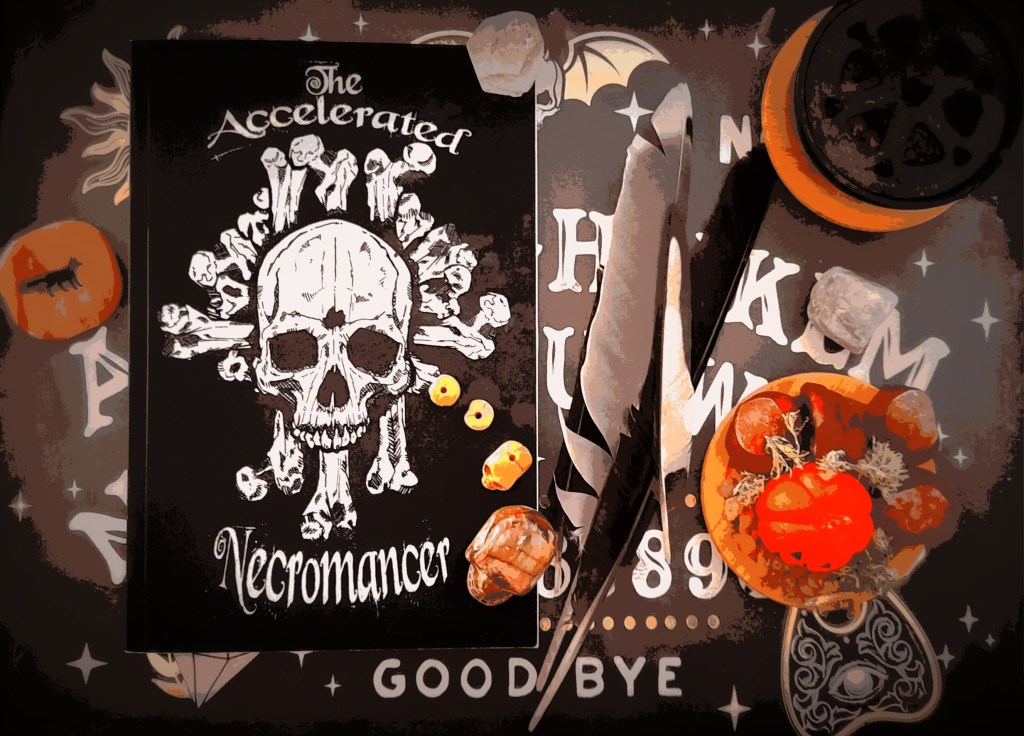
 The Accelerated Chaote